
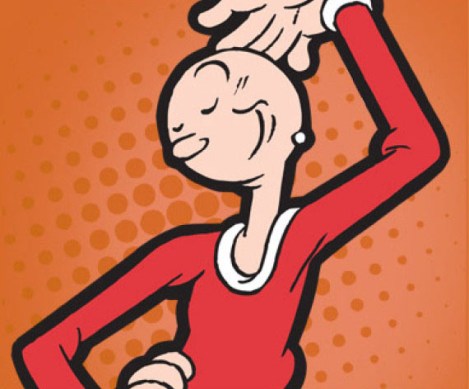
One of the first side facts I learned about my cancer treatment is that I would lose my hair. Not just the hair on my head–the hair on my body, my eyebrows, and my eyelashes would probably fall out, too. The likelihood that I would lose it all was something approaching 9/10.
It’s a fact that most people know and are familiar with. And it’s a common concern or complaint for many a man or woman undergoing treatment. Sure, there are cold cap treatments available that can reduce the likelihood that the hair on your head will fall out; however in the case of blood cancers, it is highly inadvisable to use them. Cold cap treatments work by icing or cooling the skin on scalp so that blood flow to that area is restricted. This results in a restricted access for chemotherapy drugs to that area. Meaning, your treatment will not reach your head.
Obviously in the case of blood cancers this is not a good thing. Our cancer is circulating actively through our blood and lymphatic system. Many of us many need intrathecal therapies. Cold cap treatments are not a choice for us.
So we lose our hair. So what? It’ll grow back; don’t shed any tears over it.
Or so the uninformed will say.
And it’s true. It will grow back. Hair loss commonly occurs because of the combination drugs used for chemotherapy blocks cell division. Hair follicles are some of the fastest-growing cells in the body. Normal hair follicles divide every 1-6 days. Since hair loss indicates all cells are being affected, it is generally used as a sign (one of many) that the treatment is working. But having been on the receiving end, I can honestly say that I was devastated.
My hair gradually fell out over the course of 4 cycles. First I noticed more hairs in the shower drain. Then I woke with hair all over my pillowcase. I cut it short to reduce the friction and keep it around longer. When all the hair was gone, my eyelashes proved next. I’d rub my eye and suddenly I’d have four, five lashes on my hand. My eyebrows began thinning, too. And then, by the fifth cycle, I was bald, browless and lashless. The only good part was I didn’t have to shave for summer.
But it hurt.
Why did it hurt?
I knew it would grow back. I wasn’t suddenly ugly because I lacked hair.
I realized, however, that it was many feelings bundled in one. Hair loss hurt because it represented so many parts of my diagnosis and treatment that I didn’t want to confront willingly.
- It represented my lack of control. I’d been diagnosed, whisked into the hospital and stuck with so many needles that I felt like I was in a whirlwind of what-the-heck-is-going-to-happen-next.
- It represented my guilt. Cancer doesn’t just affect the patient; it affects the whole entire family. Because of me, my family cried by my bedside, watched me worriedly when I breathed too shallowly, and couldn’t do the fun stuff we’d planned just a couple months prior.
- It represented my role in life. I felt unfeminine. How could I bat eyelashes I didn’t have? There were no flowing locks to dance in the wind–just a cute crocheted hat my mother-in-law had made for me. The treatments had significantly altered my sex drive, and I wasn’t even sure if I would be able to have children in the future. The studies indicated fertility returned to most women following my specific treatment, but I couldn’t be sure until well later.
- And it represented my identity. Before I would look in the mirror and see ME. I could cut my hair short, keep it long, do whatever I wanted, but I was the one doing it. It would be a conscious decision to change how I looked. But this hair loss wasn’t me. It happened whether or not I wanted it. You never realize how important your eyebrows are to your face until you don’t have them anymore. I wasn’t that ghostly pale person whose little egghead and sloping forehead looked back from the mirror. That was a sick patient, not the real me.
It was horrible. I cried many a silly moment just for my hair. The first time it truly came out in clumps I sat on the bathtub floor and bawled, the rush of water drowning my misery.
When I realized why it was so important, I also came to understand just how deeply my cancer diagnosis had affected me and my life. I was lucky–relatively speaking. My chemotherapy lasted less than a year. But the experience had lain roots far, far deeper than I had expected.
My hair didn’t return until three months after my chemotherapy ended. It came surreptitiously, first on the sides of my head and then moving upward. I was overjoyed when I saw my eyelashes had come back. I had drawn in my eyebrows when I had none (you’d be amazed how different you feel even with drawn-in brows, seriously), and as they gradually filled in with real hair, my brow pencil use slowly decreased.
Yet, the degree of happiness I felt didn’t even compare to the misery I’d felt as it fell out. And that was because I’d already confronted the real reasons for my unhappiness. Yes, the return of my hair was important. It marked the beginning of real healing and recovery. But most important of all was the introspection the hair loss had forced. When I was able to identify the reasons for my deep upset, I was finally able to deal with them. In the end, I not only overcame this hair loss episode, I surmounted the biggest obstacle there was: myself.
 Bitesized Life